

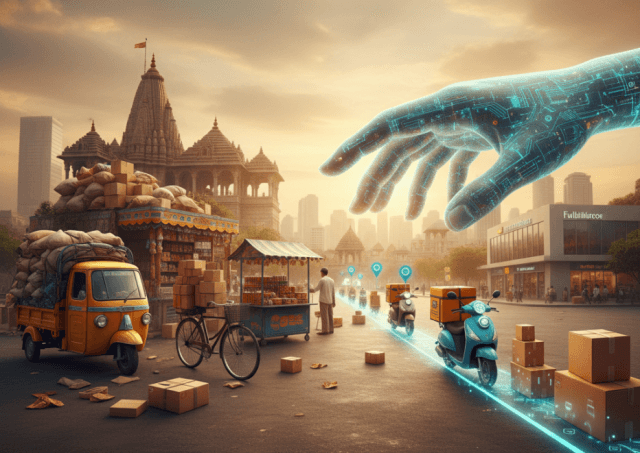
For decades, logistics in India has evolved through three distinct waves. The first was manual operations such as clipboards, phone calls, and human coordination defined how goods moved. The second brought automation, where ERPs, GPS tracking, and route management tools simplified visibility and streamlined processes.
Now, we stand at the threshold of the third and most transformative wave AI orchestration.
Lets Understanding Key Terms:
Before diving deeper, let's clarify the essential concepts:
- AI Orchestration: The use of artificial intelligence to coordinate, optimize, and manage complex logistics operations automatically, learning from data to make increasingly intelligent decisions about routing, resource allocation, and delivery planning.
- 1PL, 2PL, and 3PL: First-Party Logistics (1PL) refers to a company's own fleet and delivery infrastructure. Second-Party Logistics (2PL) involves contracted transportation services. Third-Party Logistics (3PL) are external logistics providers that handle warehousing, transportation, and distribution for multiple clients.
- Interoperability: The ability of different logistics systems, platforms, and service providers to work together seamlessly, sharing data and coordinating operations despite using different technologies or belonging to different organizations.
- SLA (Service Level Agreement): A commitment between a logistics provider and client defining expected service standards, such as delivery timeframes, success rates, and performance metrics.
- Logistics SaaS: Software-as-a-Service platforms designed for logistics operations, providing cloud-based tools for tracking, management, and optimization without requiring companies to build their own technology infrastructure.
India's Opportunity: Growth Meets Fragmentation
India's logistics landscape presents a fascinating paradox unprecedented opportunity layered with deep fragmentation.
The India e-commerce logistics market is projected to grow from USD 4.42 billion in 2025 to USD 7.85 billion by 2030, at a CAGR of 12.18%. The broader e-commerce sector continues its explosive trajectory, with India's e-commerce industry valued at USD 125 billion in 2024 and projected to reach USD 345 billion by 2030, reflecting a CAGR of 15%.
Yet this growth story faces structural challenges. Over 85% of logistics capacity still lies in the unorganized sector small courier vendors, independent riders, and regional fleet operators. MSMEs and mid-sized enterprises, which form the heart of India's retail network, face persistent delivery challenges: multiple courier accounts, limited tracking visibility, and inconsistent service level agreements.
The gap between demand scale and operational intelligence is widening and that's exactly where AI-powered logistics SaaS platforms are rewriting the playbook.
Current Barriers: The Tech Divide in Indian Logistics
While top-tier eCommerce players have embraced AI-led logistics, most of India's logistics capacity remains technologically underpowered. Here's why:
- Low Digital Adoption: MSMEs and smaller courier firms often rely on manual dispatching and WhatsApp coordination instead of automated systems. This isn't just about technology preference; it reflects a broader awareness gap about available solutions and their tangible benefits.
- Fragmented Infrastructure: Multiple third-party logistics providers (3PLs) operate without interoperability, leading to duplication, errors, and poor real-time control. The absence of standardized protocols means data exists in isolated silos across different operators.
- Cost vs. Efficiency Paradox: Many players view logistics technology as a cost center rather than a growth multiplier. The initial investment required for digital transformation often overshadows the long-term operational savings and revenue opportunities.
- Data Blindness: Operational data exists but remains unused for optimization or forecasting. Without analytics capabilities, historical performance insights that could drive better future decisions remain locked away.
AI's Role: Powering the New Era of Intelligent Logistics
AI is not just a layer of optimization; it's becoming the operating system for modern logistics. Research shows that AI-driven supply chain solutions have led to rapid data processing, accurate trend prediction, and automation of repetitive tasks, improving efficiency by nearly 40%.
1. Unifying Fragmented Supply
AI creates a single digital layer that connects independent couriers, regional 3PLs, and enterprise fleets. It analyzes their performance, capacity, and SLA adherence in real time dynamically routing orders to the best-fit partner.
Instead of a merchant manually choosing a courier, the AI engine decides instantly based on pin code efficiency, current load, delivery speed, and historical reliability. The outcome? Zero idle capacity, faster fulfillment, and higher margins for every stakeholder in the network.
2. Powering Interoperability Across 1PL–3PL Networks
The next revolution in logistics won't be about adding more fleets; it'll be about connecting the ones we already have. AI bridges this gap by making first-party (own fleet), second-party (contracted), and third-party (external) networks interoperable through intelligent orchestration Platform.
Imagine an order that begins on an enterprise's private fleet, gets handed to a 3PL for intercity delivery, and finishes via a hyperlocal partner; all tracked, optimized, and reconciled in one unified dashboard. This AI-powered interoperability breaks down silos and allows logistics to function as a collaborative network instead of isolated operators competing for the same capacity.
3. Enhancing Nationwide Fulfillment Reliability
India's size, diversity, and delivery density create unique fulfillment challenges from congested metros to remote rural pin codes. AI tackles this complexity through multiple mechanisms:
Predictive Analytics: By analyzing past trends and current patterns, AI systems can anticipate potential disruptions and proactively plan routes to avoid congestion during peak hours. This moves logistics from reactive problem-solving to proactive planning.
- Dynamic Route Optimization: Traditional static routing struggles with real-world variability. AI-powered systems collect and process live data from GPS, traffic databases, and weather forecasts, automatically identifying alternative paths when disruptions occur.
- Continuous Learning: Machine learning enables systems to improve with each delivery. As more data is collected, machine learning models improve their predictions and adapt to new conditions, leading to continuous enhancements in route planning.
- Strategic Warehousing: AI suggests micro-warehousing or cross-docking strategies to minimize transit time, ensuring products are positioned closer to demand clusters before orders even arrive.
Real-World Impact: AI in Action
Global logistics giants have already demonstrated AI's transformative potential. UPS utilizes its proprietary AI system, ORION, to enhance delivery efficiency, reducing the distance traveled by delivery trucks by approximately 100 million miles annually, resulting in significant fuel savings and reduced emissions.
In India's context, the impact extends beyond efficiency to accessibility. AI can reduce overhead costs by automating documentation, ensuring faster clearance, and enhancing cargo visibility at ports and airports, addressing one of India's most persistent logistics bottlenecks.
The sustainability angle is equally compelling. With last-mile delivery accounting for 41% of overall logistics expenses, AI-driven route optimization translates to lower fuel consumption, reduced CO₂ emissions, and decreased idle mileage and aligning economic efficiency with environmental responsibility.
The Next Generation of Logistics SaaS
The next decade of logistics SaaS in India will be built on three pillars:
- AI as the Brain: Decision-making across routing, allocation, and partner selection becomes automated and predictive. Systems don't just respond to current conditions they anticipate future patterns and adjust proactively.
- Unified Infrastructure: Every 3PL, fleet owner, and delivery partner connected through open APIs and standardized protocols. The Open Network for Digital Commerce (ONDC) initiative represents India's ambition to create such interoperable ecosystems.
- Transparent Ecosystem: Real-time visibility and performance benchmarking become available to both enterprises and partners. Data democratization ensures that optimization benefits flow to all participants, not just dominant platforms.
- Decentralized Growth: Unorganized vendors gain access to enterprise-level technology through plug-and-play SaaS platforms. This democratization enables small operators to compete on service quality rather than just price.
- Sustainability Through Optimization: Green logistics practices, including electric vehicles for last-mile delivery, biodegradable packaging, and route optimization to minimize fuel consumption, are becoming increasingly common. AI makes these sustainability initiatives economically viable by embedding them into efficiency algorithms.
In this world, every delivery isn't just a transaction; it's a data point contributing to a nationwide intelligence network that becomes smarter with each package moved.
AI Isn't Replacing People - It's Empowering the Ecosystem
The logistics industry has always been human at its core; riders, dispatchers, fleet owners, and merchants powering India's commerce every day. AI doesn't replace them; it amplifies their capabilities and decisions.
It transforms instinct into intelligence, chaos into control, and delivery into a seamless experience. The future of logistics in India isn't about more trucks or couriers, it's about smarter orchestration, inclusive technology, and unified growth.
With Flipkart creating over 220,000 seasonal jobs and planning 650 additional festive delivery hubs in tier II & III cities, the employment impact of logistics growth remains robust. Technology enables humans to do more meaningful work rather than eliminating work altogether.
As India marches toward becoming the world's second-largest e-commerce market, the logistics infrastructure that supports this growth must evolve beyond traditional constraints. AI provides the intelligence layer that makes this evolution possible not through displacement, but through augmentation.